 UltraGPT
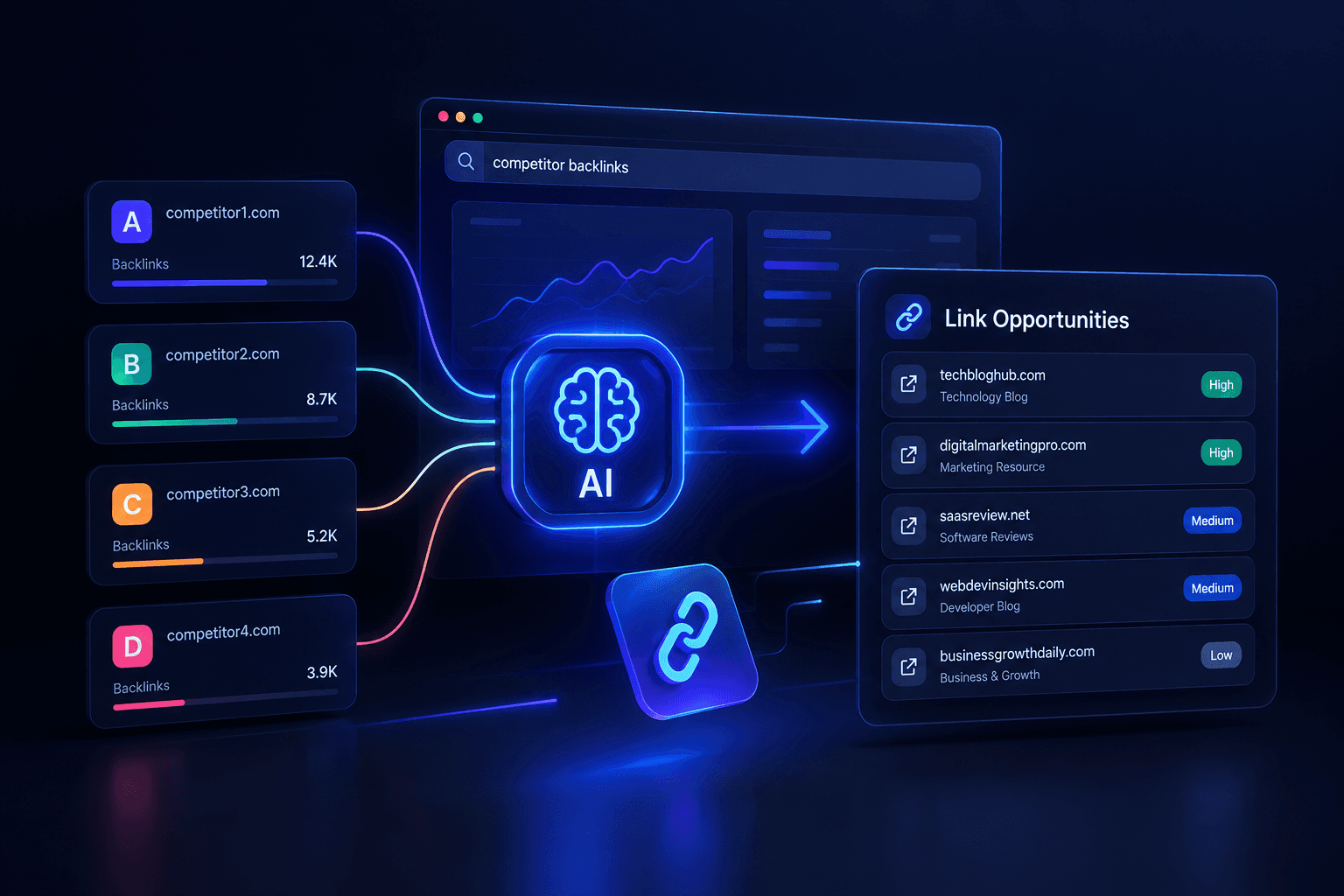
How AI Identifies Competitor Backlink Opportunities
AI has transformed backlink research by automating processes that were once entirely manual. Instead of combing through competitor sites link by link, AI tools scan competitor domains to build detailed backlink profiles, filter and rank opportunities by quality, predict where future links are likely to come from, and monitor mentions and competitor activity in real time.
- Competitor analysis: AI scans competitor domains to build detailed backlink profiles, surfacing high-impact links and patterns a manual review would likely miss.
- Filtering and prioritization: tools rank backlinks by domain authority, relevance, anchor text, and placement — keeping focus on quality links while flagging harmful ones.
- Predictive insights: AI forecasts future linking opportunities by analyzing trends, backlink velocity, and industry patterns.
- Real-time monitoring: continuous tracking of mentions and link placements helps refine strategy as opportunities appear.
Platforms that combine multiple AI models into one workflow make this practical at scale, and businesses using AI for backlink strategy report faster growth in referring domains and meaningful boosts to organic traffic.
Feeding in and analyzing competitor domains
The first step is feeding competitor domains into an AI-powered tool, which processes vast amounts of online data to construct a detailed backlink profile almost instantly — a level of speed and precision manual research can't match. Beyond just listing backlinks, AI evaluates context: whether a link comes from a high-authority site, and what the surrounding content looks like. That context is what turns a raw list of links into a focused, effective strategy.
Filtering and prioritizing backlinks
Once the data is in, AI applies advanced filters to rank opportunities using domain authority, page authority, relevance, anchor text, link placement, and spam scores together — a multi-layered evaluation that keeps effort pointed at quality links. This same pattern-matching flags harmful or low-quality links early, before they can hurt rankings.
AI also factors in timing: it tracks backlink velocity and can alert you to sudden spikes in a competitor's link-building activity. One particularly useful pattern is the link-intersect approach — finding sites that link to multiple competitors but not to you — which produces a prioritized list of realistic, high-impact targets.
Finding patterns and high-value links
AI also identifies "influencer nodes" — high-authority sites within an industry that frequently link to relevant content — so outreach can focus on the sources most likely to move the needle. It tracks which types of content are gaining backlinks industry-wide and can predict which formats are most likely to attract quality links, based on what's worked for competitors.
Continuous web monitoring extends this further: tracking brand and industry-term mentions, evaluating their context and sentiment, and surfacing link placement opportunities that fit an existing content strategy — along with gaps in competitors' approach, like overlooked niches or untapped partnerships.
Evaluating backlink quality with AI
AI tools have moved backlink evaluation well past simple link counts. Domain Authority and Page Authority remain central — top-performing sites often sit at a Domain Rating of 50 or higher — but relevance now carries real weight too: a single relevant link from a trusted site can outweigh 100 irrelevant ones.
Anchor text is evaluated for how natural it reads, with links in main content valued over those in footers or sidebars. The dofollow/nofollow distinction still matters, and traffic and engagement metrics add another signal — a link nobody clicks holds less value, regardless of its source. Spam scores round things out, catching patterns like link farms or private blog networks. Many teams now prioritize links from sites with a DR of 50+ and at least 1,000 monthly visitors.
Metrics AI tools weigh
- Domain Authority: DA 50+ with consistent growth signals quality; DA below 30 with a declining trend is a red flag.
- Content relevance: topical alignment with clear semantic connections beats unrelated or forced placements.
- Anchor text: natural, varied phrasing outperforms over-optimized, keyword-stuffed anchors.
- Link placement: editorial placement in main content matters more than footers, sidebars, or comment sections.
- Traffic quality: 1,000+ monthly visitors with real engagement beats low-traffic pages with high bounce rates.
- Spam score: a clean profile beats one flagged for manipulation or PBN association.
Predicting link value and SEO impact
Beyond current metrics, AI models predict a link's future value. Brand authority is one emerging factor — well-known brands often rank higher with fewer backlinks, since search engines tend to favor trusted, established names over pure volume. User engagement is another: time on page, bounce rate, and post-click behavior all help distinguish genuinely valuable links from ones created purely for SEO.
More advanced techniques — entity recognition, knowledge-graph analysis, sentiment analysis — verify a linking site's real authority on a topic and adjust trust if a brand has picked up negative mentions. Recency matters too: recently updated links tend to carry more weight than static ones, and tracking link velocity helps separate sustainable growth from a short-lived spike.
The overall shift is consistent: businesses are moving away from chasing backlink volume and toward trustworthy, contextually relevant links — the same standard AI now applies automatically when it evaluates a backlink profile..